Wednesday, September 8, 2010

Secrets of Mona Lisa smile

Mona Lisa. The immortal, captivating and the most wondrous creation of the renaissance maestro Leonardo Da Vinci. There is truly something enigmatic about this sixteenth-century portrait that has fascinated artists non-artists alike for generations. Presumably the portrait of Lisa Gherardini, wife of a wealthy Florentine silk merchant Francesco Del Giocondo, this painting has deeply influenced scientists, fiction writers, even conspiracy theorists. Thanks to the mystic facial expressions created by Vinci, the archetype renaissance painter. A team of French scientists have finally cracked the secret of Mona Lisa. Specialists from the Center of Research and Restoration of the Museums of France, in collaboration with European Synchrotron Radiation Facility and Louvre Museum, have studied seven of Leonardo Da Vinci's paintings in order to analyze the master's use of successive ultra-thin layers of paint and glaze, the technique that scholars believe gave Vinci's work their distinct dreamy quality. The paintings are Mona Lisa, Virgin of the Rocks, Saint John the Baptist, Annunciation, Bacchus, Belle Ferronniere, Saint Anne, the virgin and the child, all currently displayed in the famous Louvre Museum where the actual study took place.

Armed with a non-invasive technique called X-ray fluorescence spectroscopy, the distinguished team of scientists was able to study each layer of paint and their chemical compositions of each of the seven artworks. According to team leader, Philippe Walter, this equipment is so precise that “now we can find out the mix of pigments used by the artist of each coat of paint.” Published in the latest edition of the journal Angewandte Chemie, international edition, the researchers found out that Da Vinci painted up to 30 layers of paint on his works to meet his signature standard of subtlety and all the layers are less than 40 micrometers or about the half the thickness of a human hair. This is in fact a technique called “Sfumato” (common amongst the renaissance masters), which is the mixing of thin layers of pigment, glaze and oil to create lifelike shadows.

This “Sfumato” technique allowed Leonardo to give outlines and contours a hazy quality which eventually created an illusion of depth and shadow. According to the scientists, the shadows were built up by dozens of translucent layers of glaze where each layer was only one or two micro-meters thick, but each contained a carefully dosed pigmentation. It is believed that this in particular was a new technique during the Renaissance and part of the reason Leonardo and his contemporaries were able to make what had been once flat images of the Middle Ages which appear to leap from their frames into photo-like reality. And this “Sfumato” technique explains the mystic nature of the drawing of “Mona Lisa”. Experts believe that, one of the key reasons behind Mona Lisa's enormous appeal is the lifelike shadows and tones that give her enigmatically smiling face a sense of depth and reality. It was found that in the case of Mona Lisa, Leonardo used a mixture of oil and resins, a binder with a very low amount of pigments. And according to Philippe Walter, “with this mixture it was possible to create a very impressive aspect of the painting-a realistic, like a 3-D painting”. It was also found that in the Mona Lisa, Da Vinci used manganese oxide in hid shadings whereas in others he used copper and often glazes. And regarding any hidden codes or clues, perhaps more patience is in order. This study may have answered how Leonardo Da Vinci illustrated the mystic smile in Mona Lisa, but as for the actual reason behind such mysterious smile, as the saying goes “there is more than what meets the eye”; surely we need to study her more innately. 

Shariful Alam

Monday, September 6, 2010

Save the Mother Earth by keeping biodiversity & ecosystem

WHATEVER the religious scriptures depict, man as a species of living beings constitutes a negligible part of the earth's biota. Yet, having overwhelming intelligence and capacity to mould nature, he has done much harm to the environment that nurtures all of them with motherly affection. In essence, we -- the humans -- have been a destructive species that has caused irreparable damage to mother nature just for rapid production of our utilities and to lead an easier and rather lavish life. 

However, after axing our own feet, we could realize that such destructive activities have harmed our own well-being, and have started crying for sustainable development using as much renewable energy as possible, reducing carbon emission to avert or at least minimise green-house effect and global warming that are contributing largely to melting of ice caps, sea level rise and unforeseen climate changes. 

There were four major organised international efforts at sustainable development to retain the natural biodiversity as much as possible in the ecosystems. The first one was held in 1972 by the United Nations General Assembly in Stockholm on the issue of Human Environment. On the same platform, one more resolution was adopted, which gave birth to the United Nations Environment Programme (UNEP). That Stockholm conference decided to celebrate World Environment Day on June 5 every year.

World Environment Day (WED) is the main weapon of the United Nations to make people aware of the worldwide environmental degradation, and to attract the attention and action of various political sources and human resources. Now over 100 nations around the globe celebrate this event. Every year, the UNEP coins a theme and its central program is arranged in a specific place. This year's theme was “Biodiversity -- ecosystems management and the green economy” and the venue Pittsburgh.

At the state levels, various resolutions and pledges are taken by prime ministers, chief ministers and ministers for environment on WED. They make commitments to take care of the world environment. The pledges are then established as the basis of environmental management and economic planning dealt with by the government.

In Bangladesh, the first and foremost state program is the seasonal tree plantation campaign that is inaugurated by none other than the head of the government. This is usually done on June 1, four days before the international WED. Our ministry concerned also arranges street rallies on the scheduled day. Furthermore, we also arrange essay and poster competitions in schools, while the clean-up campaigns are usually arranged by some non-governmental organisations, especially the environmental groups like Bangladesh Poribesh Andolon (BAPA). 

Now let's dwell on the theme of this year's WED. Here “biodiversity” comes first. The term refers to the existence of diverse biota (species diversity) in the various types of ecosystems (ecosystem diversity). Another term, “genetic diversity,” signifies especially the different varieties of living beings (containing diverse genetic constitution) inside a species of plant, animal or microbe. We must note that both genetic and species diversities need diverse ecosystems (and in micro-level, different niches) to sustain and thrive. 

Once we destroy even partially the underground, surface and aquatic ecosystems (along with the atmosphere), unwisely creating only some artificial (secondary or tertiary) forests, and confine aquatic biota to closed water bodies (lakes and ponds) we actually close or limit the scope of sustenance and growth of diverse flora and fauna. Hence, UNEP properly placed the term “ecosystem management” just after biodiversity. 

How can we manage the natural ecosystems? In countries like Bangladesh, where geometrically increasing human population is literally eating up space (ecosystems) essential for all other biota, how can we still leave the spaces that other living things deserve to have?

There is a two-way solution. One is to arrest further growth of our own species. The other way is wiser living. We must occupy lesser earth surface for our living, i.e., living in vertical spaces, in high-rise buildings. Another way to keep some spaces available for other living things is decentralisation of human organizations, including dwelling houses, social establishments and industries. 

Most people's longing for living in cities (thus leaving no space in large continuous areas of concrete jungles for other living things) can be changed by sincere state efforts through sound policies of turning the whole country into a mix of urban and rural communities rather than concentrating all urban facilities in cities. This refers to green economy all through a country and, in turn, worldwide. 

However, “green economy” cannot be established by a single state, or even a region. That's why three major international efforts, other than Stockholm declaration, were made. These are the Rio Declaration (1992), Kyoto Protocol (2002) and Copenhagen Summit (2009). 

The last summit was termed by many as failed and by some as an opportunity. To me, this summit was just saved from a total failure by the last minute efforts. Why are most industrialised states -- both western and eastern -- still reluctant to reduce carbon emission and rely more on renewable energy? The answer I find is that they do not realise the very basis of environmental concerns that created UNEP, WED, Rio, Kyoto and Copenhagen. 

What is that? That's the very first proclamation of the Stockholm declaration, which states: “Man is both creature and moulder of his environment.” Leaders in most developed countries still like to “mould” the environment further by using technology, forgetting that the environment thus moulded shall turn unsuitable for living of “creatures” of nature that we actually are. So, please stop further moulding of nature, let's rather mould our psyche to avert the 27th destruction of earth that can make room for the 28th evolution of life (An evolution theory says: living things have evolved 27 times so far after large scale destruction).


Shariful Alam

Sunday, September 5, 2010

Save Old Dhaka

IT is time to think and talk about old Dhaka and the people living there. It is more pertinent to do so after the tragic fire incident at Nimtoli that claimed so many lives recently. We must not let it happen again. Old Dhaka is unique by every definition. It has a character of its own that can be felt only by people who continue to live there or who had lived there for at least a good number of years. New Dhaka lacks that character. 

Puran Dhaka, as it is popularly called, is a moving canvas of colour, faces, food, dress, language and lifestyle that can hardly be emulated by outsiders. It is the part that never sleeps. It is the part where most of our traditions, heritage and pride linger in every nook and niche, silently bearing testimony to many historic events for the last four hundred years. Old Dhaka must survive. Old Dhaka must live. If it is gone, we will be left with no past; no history.

As we see the population increasing like crazy everywhere, old Dhaka is no exception. But, not all are genuine Dhakaiaas who live there. At the moment, a guesstimate is that one third of the population there is constituted by people coming from other districts. 

This gradual infiltration by aliens has not only alarmingly diluted the original character of old Dhaka but has also created a demand for more living space. But, as space is a big constraint in that part, house owners have opted to go skyward to earn rents. 

They are building floors on weak foundations despite the fact that most buildings have outlived their allotted time. The invasion has in turn created tremendous pressure on the utility service supply system in the entire area from Wari to Wiseghat, from Laxmi Bazar to Lalbagh. The increasing number of people, shops, hotels, restaurants, schools, cars and rickshaws has resulted in the narrowing down of the roads and lanes in the area. 

What the government must do on an emergency basis, if it is serious about not allowing any man-made disaster striking again, is formulate a pragmatic policy of creating a new residential area for the people of old Dhaka -- for the genuine Dhakaiaas that is. Offer them compensation package for dismantling their dilapidated buildings. Then find land for them and sell plots on instalment basis. Where would the government find land in old Dhaka? There is a solution. 

Remove the Central Jail. Take it to somewhere in Savar or Gazipur or anywhere. The Central Jail is situated on a large area, which can be cleaned up and then divided into hundreds of plots. Those plots would be sold on lottery basis. No minister's nephew would be eligible to apply. Everyone will have to submit evidence to prove that he or she has been living in old Dhaka for five to six generations. 

As an alternative step, the government can construct spacious, modern multi-storied residential buildings and sell flats to the Dhakaiaas. The entire enclave should be built with a modern concept. There should be wide roads criss-crossing in all direction with a park and a shopping mall for the residents. There should also be a small field for children to play in. The demand for such flats would rise among the people in old Dhaka. But, where is land to construct more flats? There is a solution. 

Remove all the tanneries from Hazaribagh and remove all factories and illegal warehouses from old Dhaka and you will have sufficient land to construct hundreds of flats. Hazaribagh itself is almost half the size of Dhanmondi residential area. One can visualise how many flats the government would be able to construct there; how many old Dhaka families would be able to live amidst fresh air and sunlight. Then why don't they do it?

Here everything stops. All good ideas and good initiatives come to a dead end when we ask the government to do something. Why? because, government does not belong to anyone, neither does it belong to itself. It is a strange conglomerate, if we may say so for argument's sake, constituted with some strangers who do not know each other well and do not share any common interest. Each member of the government has his or her individual interest to fulfil. 

Then who would do it? Private developers? But, cynics say that most of them are even worse than the East India Company. Well, a dilemma indeed and we shall have to find the best way as to how we can help our brothers living in old Dhaka. To reach a solution, let us form a strong committee comprising some highly respected, elderly citizens who would visit the entire old Dhaka, talk to the people, talk to the local leaders and seek their advice regarding how the crisis of residential quarters can be overcome. 

The time bomb in old Dhaka is ticking. The ominous signs are there. If we do not act fast, greater man-made disasters will take more lives. Someone, some organisations will have to come forward with the good intent to help solve the problems. The commercial banks have been doing good business in old Dhaka for over a century under different names. Can they all get together and set aside a big fund from their CSR account to undertake massive facelift work? 

Whether government or private sector, the bottom line is Save Old Dhaka. 


Shariful Alam

Thursday, September 2, 2010

Science and/with Rabindranath


WHY should Biswa Parichay (our universe) by Rabindanath Tagore, written so long ago in 1937, be a matter of discussion today? This is because the scientific-minded Tagore comes up less in our discussion than the God-loving poet. This type of discussions has given rise to many interpretations and misinterpretations about the great mind of the poet.

There is another less discussed side of the poet, who has contributed to not only our literature but also to our nation-building efforts. Putting him only within books deprives us of the vision for going ahead in the modern world.
 

Rabindranath, with some of his contemporaries -- though towering above them all -- showed us the way forward. Just reading his popular poems and listening to his songs pulls down him to a narrow place in our national life.
 

What is the significance of
 Biswa Parichay? It makes us realise that the nation cannot develop without learning and practising science. Practising science does not mean only using electric fan, mobile phone, television, laptop, etc., or becoming a doctor or an engineer. 

Beyond these, it is necessary to study, think about, debate over, assimilate in life and contribute to the development of science.
 Biswa Parichay is a book on science written for children. The poet said that he wrote it just to show the way of discussing science in an entertaining and understandable manner for all. Many critics call it the best book on science in Bangla literature. 

In it, the poet has discussed physics, biology, chemistry, astronomy, all in a manner of telling a story combining science with life in society. This is the one characteristic that has made this unique among all Bangla books on science.
 

When our intellectuals are struggling to find Bangla terms for scientific words and are at wit's end, there is a good example in this book which shows that there is no barrier to discussing the most complex scientific ideas in the Bangla language.
 

This book is not only a scientific explanation of the world, but also a linguistic explanation of it. After discussing the growth and development of the universe, Tagore said, almost in passing: “Eijonnoi amader bhashay ei bishshoke bole JaGaT. Orthat er shongga hochchhe e cholchhe, cholatei er utpotti, cholai er shobhab" (So in our language this universe is called jagat. The definition of it is it is going on, it grows out of movement, and its nature is to keep moving).
 

I learnt from the writings of Kalim Khan, a linguist in West Bengal, India, that in the Bangla word ja-ga-t, ja = origin, ga = development and t = revolutionary change. (Paroma Bhashar Shongket
 by Kalim Khan, published by Papyrus, Dhaka.) 

Since Tagore wrote this book many scientific ideas and information have changed. Except those few things, the book is as new as if it was written yesterday. It is known that more school students in our country prefer humanities and commerce to science. This is because presentation of science, the most interesting subject of all, is very insipid in our classrooms and so students fail to enjoy the reading of it.
 

Those who study medical science and engineering do so not so much either for their interest in science or for working for humanity as for the money these professions will fetch -- yet there are not many doctors and engineers in our country. Again, a scientific outlook is necessary for everyone, irrespective of what group s/he studies in; it is imperative for the development of the nation as well.
 

There are five chapters in this book. Notes can be given at the end of each chapter, showing the changes in modern scientific ideas. Each chapter can be studied in different grades. This article is written as an appeal to the Ministry of Primary and Mass Education to make
 Biswa Parichay compulsory reading for all from Class IV to VIII. 

It will help learners achieve a scientific outlook, understand that all branches of knowledge are unified at a deeper level of understanding, remove some harmful misunderstandings about Tagore from our social life, and ultimately learn to have joy in earning knowledge about our
 JaGaT.

Shariful Alam

Tuesday, August 31, 2010

The Bengal Legend: Shamsur Rahman

If Robindranath Tagore was the last poet in the Bengali tradition, Jibanananda Das was the first of a new breed. And this new breed, in the trend of Bengali modern and post modern poetry, has been unarguably continuous with the powerful contributions of Shamsur Rahman.

Shamsur Rahman emerged in his time as the most popular poet of modern Bengali literature. Popularity apart, Shamsur Rahman had distinguished himself as an extraordinary poet presenting a paradigm hitherto best chosen. It is a fact that his most familiar poetic diction, choice of words and thematic preferences took not much time to reach the heart of the readers. Today it can be said without exaggeration that the poetry of Shamsur Rahman has become the defining essence of modernism in 21st century Bengali poetry.

Shamsur Rahman was born on 24th October 1929 in Dhaka. He studied at Pogos High School [matriculation in 1945], Dhaka College and Dhaka University. Shamsur Rahman wrote most of his poems in free verse, often with the rhythm style known as Poyaar or Aakhsharbritto. It is popularly known that he followed this pattern from poet Jibanananda Das. He also wrote poems in two other major patterns of Bengali rhythmic style, namely, Matrabritto and Shorobritto. 

Of Bengali modern poets, poet Shamsur Rahman was equally popular in both Banglas. Surely, his early poems bear the influence of Jibanananda's and some other poets like Satyendranath Dutta and Buddhadeb Bose. However, before long, he thoroughly overcame all influences and created a post modern poetic diction. However, as his style and diction matured, his message appeared to touch urban hearts. In fact, he gave huge attention to liberal humanism, human relations, romanticised rebellion of youth, the emergence of consequent events in Bangladesh, and opposition to religious fundamentalism in his poetry and writings and these were considered mostly comprehensible. His poetic talent has reserved a crown for him in Bengali modern poetry. 

Bengali literature received a big blow with the death of Bangladesh's poet laureate Shamshur Rahman in 2006. 


Shariful Alam

Monday, August 30, 2010

Digital distractions

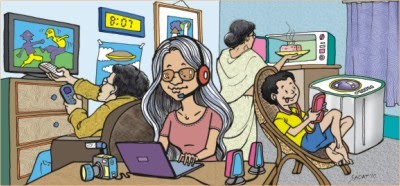
Imagine you are sitting in your living room, looking at your friend's new photos on Facebook. Old friends start to send instant messages, and you have your email account open on a different window. Other links are also open, where you are browsing for information. Your television is also switched on and your cell phone rings, you pick it up, and while conversing, you try to read and send a text message. Looking obliquely from the corners of your eyes at the computer screen and someone enters your room and you finish your important family talks.

You must be thinking that this is exactly what you do. It doesn't take much imagination to conjure up this scenario, because in this era of technology, all of us go through this situation. But a growing body of research suggests that people are paying a mental price for their addiction to electronic gadgets.

Today's office workers face a lot of distractions. There are some with a Facebook obsession and others who check multiple e-mail accounts throughout the day. Inside office cubicles, workers can surf the web or text without worrying about whether anyone is looking over their shoulder. 

It is also common for students to browse the internet with their cell phones in classrooms and while riding CNGs three-wheelers or rickshaws. 

Digital distractions are everywhere.


We have so many ways of communicating that it's nearly impossible to simply answer a call, research something online or jot down a note without transitioning to other tasks.

PC World recently published an article saying the biggest digital distracters are calls and texts from our cell phones, emails, instant messages and social networking sites, like Facebook and Twitter.

The article is great because so many of us don't realise how much time we drain on these forms of remote communication. They've become so deep-seated in our day to day lives that, for some of us, it's hard to imagine what the world would be like if we didn't know whether someone has changed his/her profile picture or not, or what your cousin and friends abroad are doing. 

In 2009, David McCandless, a writer, conducted a survey, The Hierarchy of Digital Distraction, to spot the attention-grabbers. The iPhone and e-mail topped the list. 

The hierarchy showed the entries at the top of the pyramid wins attention over the lower levels. Landline still has a place, but it is thoroughly trumped by anything coming in on your iPhone.

Facebook makes a surprisingly low showing, occupying only the lowest two levels of the hierarchy.

At the very top of the pyramid is the ultimate arbiter of them all: significant other closing the laptop lid on your fingers. At the very bottom? Any kind of actual work.


Nevertheless, we cannot controvert the fact that rapid advances and continuous innovation in technology have made the world a smaller place. The internet has made it possible to access information and communicate free of charge with a person sitting at the other end of the world at the click of a button. 

It is amazing how technology has slowly entered our lives and become a part of our daily activities, even without our conscious knowledge.

When using technology, we should keep in mind the best and worthy use of it. Our goal is a harmonious balance between our daily productive lives and feeling like we are still clued in on the world around us being completely digitised.

Let us see whether the points below can help us come up with ways to take away the distraction part from the equation. 

Schedule your surfing -- Give yourself a block of time to catch up on all your Facebook contacts, personal email, and news feeds. 

Create a schedule that allows you to check in with your inbox, friend's list and social networking friends on a reasonable basis. 

Limit yourself to one email account, Facebook page and instant message screen name. 

If you are constantly refreshing a favourite site or pressing send/receive on your mail client, then you are not actively engaged -- you are probably avoiding your long-term priorities, which show you are wasting time and energy.

While you are trying to read something online, do not log on to social networking sites. Stick to that very topic, do not open more than four or six links on different topics or else, you will end up remembering nothing.

Settle on a schedule that works for you. We all have different priorities, commitments and levels of activity. Determine how much time you can comfortably spend “plugged in” to these digital distractions and work from there. 

If possible, make more time for people, not people's emails, status updates or instant messages. When we engage with people face-to-face, we're able to dive a lot deeper into conversation, resulting in a pleasant experience for both parties. 

Limit the number of times you check your phone while you are really working on something online.

A break from work should be a restorative action, chatting with a friend online about your project isn't a break. It's a distraction.

Distractions exist because we allow it. It's human nature to wonder what we're missing and we want to be the first to receive an update from a loved one or a piece of gossip from a well-placed source. E-mails, text messaging, push updates, and chat sessions may make us more productive than we've ever been -- in fact, they may be vital in helping us do our jobs, but for many, it may reduce the ability to focus on a single task for more than a few minutes at a time. Rather than multitasking, we are being distracted.

Shariful Alam 

Digital Bangladesh: Farmers wise up online


A big chunk on the map of Bangladesh happens to comprise of rural areas. Thus, the dream of a 'Digital Bangladesh' can never be achieved by leaving behind the interests of our rural co-habitants. Everyone has the right to information and development. But Bangladesh Institute of ICT in Development (BIID) took the provision of this right one step further by providing them with a very modern solution to the problems of our rural farmers by launching their e-krishok campaign. The campaign provides farmers with information and advisory services, so that the farmers can increase their income as well as generate new sources of income.
Bangladeshi farmers have to go through numerous hardships. Natural calamities cannot be avoided. However, if the farmer knew when to expect one and thereby take appropriate preventive measures, maybe  some of his crops could be saved. Besides natural calamities, he is always running the risk of crop infestations and rainfall that is either too low or too high, thereby producing poor yields. Due to poor education, many farmers may be following the practices of his fore-fathers blindly, without looking for better agricultural methods or practices.
Without proper information, a farmer whose crops have been infested by pests, for example, would think that this is the end and that his crops are only destined to die. This would mean a bad income that year, and no food for his family.
So what if this farmer was armed with easy access to the correct information at the correct time? This could lighten his load by ridding him of numerous uncertainties during his agricultural process and thereby raise his family's living standards. A better living standard for the farmers would mean a more developed Bangladesh. This is the prime aim of the e-Krishok campaign.
Through e-Krishok, farmers can get information and advice not just on agricultural issues, but also on other issues relevant to the Bangladeshi farmer, like animal husbandry, fisheries, rural cottage industry and handicrafts.
BIID , with support from UNDP, has teamed up with Grameenphone by setting up Community Information Centres all over the country. In the pilot phase, 10 Centres had been opened in various locations, but the aim is to scale this up to more than 1000 locations in the country.
So how does this e-krishok campaign work? When a farmer faces a problem or needs information relating to an agricultural or animal husbandry issue, he only has to visit his nearest community information center and using the e-Krishok agricultural services, the farmer can get reliable and correct information as to what he should do. The farmer has to inform the entrepreneur of the CIC the nature of his problem or the kind of information he is looking for. The entrepreneur then searches for the solution on http://www.ruralinfobd.com or if the solution is not available there, he e-mails the information of the problem to the agricultural expert of e-Krishok. The agricultural expert will get back to him with a solution via an e-mail. This way, the farmer can get a solution to his problem within a 24 hour time span.
BIID is also engaged in the process to build the capacity of the CIC entrepreneurs to provide better services and facilities to the customers thereby adding value to the user experience of the customers. The District Commissioner Offices are leading the initiative of training on using the Computer, Internet and all other ICTs with the support of a 150 trainers pool. More and more people are getting trained on how they will run their telecentre and what will be their role. This again would help in raising employment opportunities in the rural areas.
The achievements of this campaign are after setting up more than 100 information centres were as follows:
Around 1400 farmers could be reached either directly or indirectly through the campaign. They now have around 1200 registered members. A total of around 6000 queries of framers have been handled by the CICs and around 1800 farmers have reported to have benefited from applying the information or advice of the CICs.
Initially, it is but natural for the farmers to be cautious and mistrustful of anything new, especially something that they do not understand. However, the e-Krishok campaign has shown the farmers that they can rely on ICT to improve their livelihoods through better techniques and practices.
Here's to a greener 'Digital Bangladesh'.
Shariful Alam